

Permanent Dentures: What They Really Are, the Types, and Who They Suit
Most people who search for permanent dentures have had enough of something. A lower denture that floats when they talk. Adhesive that never quite holds through dinner. A plate across the roof of the mouth that dulls the taste of food. The idea of teeth that simply stay put, the way natural teeth did, is easy to understand.
The term itself is a little slippery, though. Dentists, denturists and clinic websites use “permanent dentures” to describe a few different things, and the differences matter for cost, surgery, cleaning and how the teeth feel day to day. This guide sorts that out. It explains what a permanent denture usually means, the main types, how they compare with removable options, who tends to be a good candidate, what the treatment looks like from first visit to final teeth, how to care for them, what drives the cost, what the Canadian Dental Care Plan (CDCP) says, and what to ask before you commit.
This is general education, not a diagnosis or personal dental advice. Whether fixed teeth suit you depends on your jawbone, gums, general health, medications, budget and personal goals, so the decision belongs to you and a licensed dentist, with your denturist involved where removable options are on the table.
What are permanent dentures?
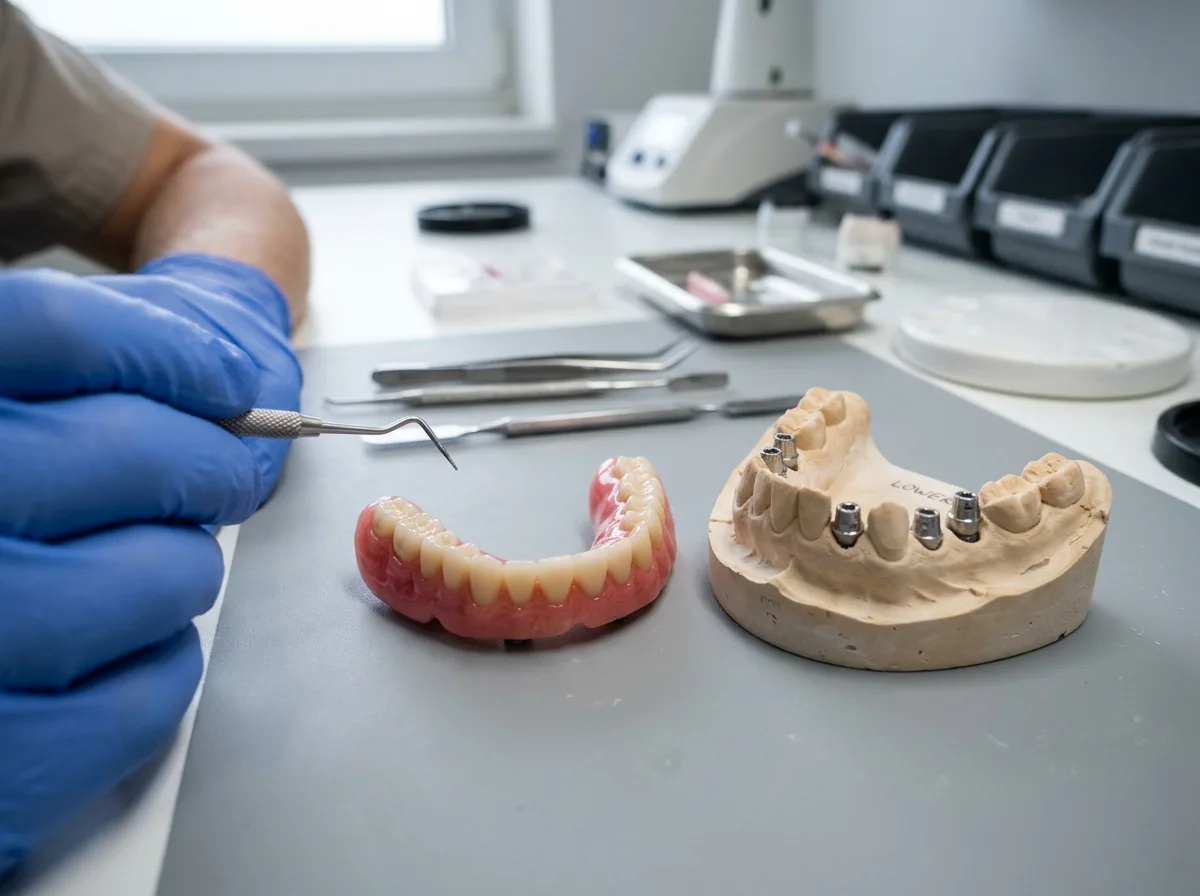
Permanent dentures are a full arch of replacement teeth fixed to dental implants in the jawbone. You do not take them out at home. A dentist can remove them for maintenance, which is why many clinicians prefer the terms fixed implant denture, hybrid denture or full-arch implant bridge. They replace all the teeth in the upper or lower jaw, or both.
A conventional complete denture rests on your gums and stays in place through suction, the shape of your ridges, your cheek and tongue muscles and sometimes adhesive. A permanent denture works differently. Several implants are placed in the jaw, they bond with the bone over time, and the arch of teeth is screwed onto them. Because the implants carry the biting load, there is no plate over the palate and nothing to slip.
Why “permanent” is a slightly misleading word
Nothing in the mouth is truly permanent. The implants are meant to stay for the long term, but the teeth and base attached to them wear like any restoration. Over the years they may need repairs, new screws, a fresh set of teeth or a full remake. People also sometimes hear “permanent” and assume it means low maintenance. In practice, fixed teeth need careful daily cleaning and regular professional checkups, which we cover below.
The names you will see
You may come across all of these used for overlapping ideas:
- Fixed implant denture or fixed hybrid denture: denture-style teeth and pink gum material on a rigid frame, screwed to implants.
- All-on-4 or All-on-X: a brand-style name for a full arch on four (or more) implants. Our guide to All-on-4 dental implants in Toronto goes into that approach in depth.
- Full-arch implant bridge: often used for zirconia or porcelain versions that look more like a bridge than a denture.
- Snap-in or snap-on dentures: these are removable. They clip onto implants but come out for cleaning. Some websites call them permanent, which causes a lot of confusion. Our article on overdentures explains how they work.
The main types of permanent dentures
When someone says “permanent dentures”, they usually mean one of a few designs. The table below gives a side-by-side view. Snap-in and conventional dentures are included because they are the options people most often weigh against fixed teeth.
| Option | Removable at home? | Typical number of implants per arch | Covers the palate? | What it is usually made of |
|---|---|---|---|---|
| Conventional complete denture | Yes | None | Upper usually yes | Acrylic base with acrylic or composite teeth |
| Implant overdenture (snap-in) | Yes | Often 2 for a lower, more for an upper | Upper sometimes reduced or palate-free | Acrylic denture with attachment housings |
| Fixed hybrid denture | No, removed only by a dentist | Commonly 4 to 6 | No | Acrylic or composite teeth on a metal or reinforced frame |
| Zirconia full-arch bridge | No, removed only by a dentist | Commonly 4 to 6 or more | No | Monolithic or layered zirconia, sometimes on a titanium base |
The implant numbers in the table are typical ranges, not rules. Bone volume, bite force, the upper versus lower jaw and the dentist’s planning all change the count.
Fixed hybrid dentures
This is the design most people picture. It looks like a denture, with pink gum-coloured material and denture-style teeth, but it is screwed onto implants and has no palate or flanges covering your gums the way a removable denture does. The acrylic or composite teeth are kinder to an opposing natural or denture arch and are relatively straightforward to repair if a tooth chips. The trade-off is that acrylic wears and stains over time, so the teeth may need replacing years down the line.
Zirconia and other full-arch bridges
Zirconia is a very hard ceramic. Full-arch zirconia bridges tend to resist staining and wear, and some people prefer how they look. They are usually more expensive, harder to adjust or repair chairside, and their hardness can be tough on whatever teeth they bite against. Whether zirconia or acrylic suits you depends on your bite, any grinding habit and what is opposite.
Snap-in overdentures: the “semi-permanent” middle ground
An implant overdenture clicks onto implants or a bar but still comes out. It usually needs fewer implants than a fixed arch, costs less and is easier to clean because you can take it out and brush it at the sink. For many people, especially with a loose lower denture, this is a very practical choice. If you are comparing the two, our pages on implant-supported dentures and snap-on denture costs are useful background.
What about bridges for a few missing teeth?
If you still have healthy teeth on either side of a gap, a full arch of fixed teeth is not the usual answer. A dental bridge, single implants or a partial denture may make more sense. Permanent dentures are generally for people who have lost, or are about to lose, all the teeth in an arch.
Permanent dentures vs removable dentures
Neither option is better for everyone. It helps to look at how each one fits into a normal week rather than at a list of features.
| Day-to-day factor | Fixed (permanent) denture | Snap-in overdenture | Conventional denture |
|---|---|---|---|
| Stability when eating and talking | Very stable, does not move | Much steadier than a conventional denture, some movement possible | Varies with ridges, saliva and fit, lower dentures are often the hardest |
| Surgery needed | Yes, several implants and often extractions | Yes, fewer implants | No, though extractions may be needed first |
| Cleaning | In the mouth, with floss threaders, interdental brushes or a water flosser | Out at the sink, plus cleaning the implant attachments | Out at the sink |
| Taste and palate coverage | Palate left uncovered | Upper can sometimes be reduced | Upper usually covers the palate |
| Upfront cost | Highest | Moderate to high | Lowest |
| Repairs | Usually need the dentist to remove the arch | Often done at a denture clinic | Often done at a denture clinic, sometimes the same day |
| Night-time | Stays in | Usually taken out overnight | Usually taken out overnight |
For a broader comparison of implants and dentures, see dental implants vs dentures. If you already wear a conventional denture and mostly struggle with a loose lower, it may be worth asking about a reline, a new denture or suction dentures before deciding surgery is the only route.
What people usually like about fixed teeth
The most common things patients mention are confidence when laughing or speaking, being able to bite into more foods, not using adhesive and not having a plate over the roof of the mouth. Because implants transmit chewing forces into the bone, they also help preserve the bone around them, which a conventional denture cannot do.
What people find harder than expected
Cleaning under a fixed bridge takes practice. Speech can feel different for a few weeks, especially with s and f sounds. Food can collect under the arch. And if something breaks, you cannot just drop the teeth off for repair, because the dentist usually needs to unscrew them. Being honest with yourself about these points is part of choosing well.
Who is a good candidate for permanent dentures?
A good candidate is usually an adult missing all or most teeth in an arch, with enough healthy jawbone (or the option of bone grafting) to hold several implants, controlled general health, no active untreated gum infection, and the ability to clean around the implants every day and attend regular maintenance visits.
Age on its own is rarely the deciding factor. Plenty of people in their seventies and eighties have implants. What matters more is health, healing, bone and daily routine.
| Factor | Why it matters | What the dental team may do |
|---|---|---|
| Jawbone volume and density | Implants need enough bone to anchor in | 3D imaging, angled implants, grafting or a different plan |
| Gum health | Active infection raises the risk of problems around implants | Treat gum disease first |
| Smoking or vaping | Linked with poorer healing and more implant complications | Discuss quitting or cutting back before and after surgery |
| Diabetes and other conditions | Poorly controlled conditions can affect healing | Coordinate with your physician and review recent results |
| Medications | Some bone medications, blood thinners and other drugs change surgical planning | Full medication review, sometimes with your doctor |
| Past head and neck radiation | Can affect bone healing | Specialist planning |
| Grinding or clenching | Extra force can break teeth or loosen screws | Material choice and a protective night appliance |
| Hand dexterity and daily routine | Fixed teeth need careful cleaning every day | Choose tools that suit your hands, or consider a removable design |
When a removable option may be the better fit
A snap-in overdenture or a well-made conventional denture can be the more sensible choice if surgery carries higher risk for you, if bone is very limited and grafting is not appealing, if cleaning around fixed teeth would be difficult, or if the cost of a fixed arch is out of reach right now. Choosing a removable denture is not settling. It is a legitimate option that works well for a great many people. Our guide on replacing missing teeth without implants covers several non-surgical routes.
Can you get permanent dentures if you have bone loss?
Often, yes, though the plan changes. Dentists may angle implants to use the bone that is there, place shorter or narrower implants, graft bone first, or in more advanced cases refer to a specialist who works with techniques designed for severe upper jaw bone loss. Some people with significant bone loss are better served by an overdenture. Only an assessment with 3D imaging can answer this for your mouth.
Who does what: dentist, specialist and denturist
Fixed implant teeth involve surgery and fixed restorations, which fall within dentistry. In Ontario, dentists are regulated by the Royal College of Dental Surgeons of Ontario. A general dentist with implant training, an oral surgeon, a periodontist or a prosthodontist may plan and place the implants and deliver the final bridge. A dental laboratory builds the teeth and frame.
Denturists are regulated separately by the College of Denturists of Ontario. Their practice centres on removable dentures, which includes conventional dentures and removable implant overdentures. Many people see a denturist for their transitional or immediate denture during healing, or when they decide a removable option suits them better. For a fuller explanation, read our article on denturist vs dentist.
At Osmin Dental Clinic & Denture Laboratory, dental implants and denture services are offered under one roof, alongside an on-site denture laboratory, so the removable and implant sides of a plan can be discussed together.
The treatment process, step by step
Timelines vary widely. Some people have extractions, implants and a temporary fixed arch on the same day, then wait months for the final teeth. Others need extractions, healing and grafting before implants can go in. The table outlines the usual stages.
| Stage | What usually happens | What to ask about |
|---|---|---|
| 1. Consultation and assessment | Medical and dental history, exam, discussion of goals and options | Fixed vs removable, rough budget, who will be involved |
| 2. Imaging and planning | X-rays and usually a 3D cone beam scan, impressions or digital scans, bite records | Bone quantity, implant number and positions, need for grafting |
| 3. Preparing the mouth | Treating gum disease, extracting failing teeth, sometimes grafting | Healing time, temporary teeth during this stage |
| 4. Implant surgery | Implants placed under local anaesthetic, sometimes with sedation | Anaesthesia options, recovery, pain control, time off |
| 5. Temporary teeth | A provisional fixed arch on the implants if stability allows, otherwise a removable temporary denture | Diet rules during healing, what happens if a temporary breaks |
| 6. Healing and integration | Bone bonds to the implants over several months | Check-up schedule, warning signs |
| 7. Final teeth | New scans or impressions, try-ins for look and bite, final arch fitted | Material choice, shade, how the bite will be checked |
| 8. Maintenance | Regular reviews, hygiene visits, periodic removal and cleaning of the arch | How often, and what each visit includes |
Consultation and imaging
The first visit is mostly a conversation. Bring a list of your medications, any recent medical letters, and a sense of what bothers you most about your current teeth or denture. The team will look at your gums and any remaining teeth and usually arrange 3D imaging, because implant planning depends on exact bone measurements that ordinary X-rays cannot show. If you want to get organized beforehand, our checklist for preparing for an implant denture procedure is a good starting point.
Extractions and same-day teeth
Many people who choose permanent dentures still have some failing teeth. These are removed, sometimes on the same day the implants are placed. Our page on tooth extraction explains that part. If the implants are firm enough at placement, a temporary fixed arch can sometimes be attached within a day or so, which is where “teeth in a day” marketing comes from. If not, you wear a removable temporary denture while things heal. The immediate dentures guide covers what living with a temporary denture is like.
Healing and osseointegration
Implants work because bone grows into close contact with their surface, a process called osseointegration. It takes time, commonly several months, and the temporary teeth are designed to protect the implants while it happens. A soft diet is usually advised early on. You can read more about this stage in osseointegration of dental implants.
Final teeth and the first weeks
Once healing is confirmed, the final arch is designed from new records. There are usually try-in appointments to check tooth shape, shade, lip support and bite before the final version is made. Expect some adjustment when it goes in. Speech often settles within a few weeks, and your tongue will explore the new shape for a while. Our article on the first month with implant dentures covers the early adjustment period in more detail.
Does getting permanent dentures hurt?
The surgery itself is done under local anaesthetic, sometimes with sedation, so you should not feel sharp pain during it. Afterward, swelling, bruising and soreness are common for several days and are usually managed with medication your dentist recommends, cold compresses and a soft diet. Pain that worsens after the first few days should be checked.
Most people describe the recovery as similar to, or somewhat more than, having several teeth extracted. Your experience will depend on how many implants are placed, whether grafting is done and your own healing. Plan a few quiet days at home, arrange help if you live alone, and keep soft foods ready.
Normal healing vs reasons to call
| Usually expected | Call your dental team soon | Seek urgent or emergency care |
|---|---|---|
| Swelling that peaks around day two or three, then eases | Swelling or pain getting worse after day three | Swelling spreading to the eye, neck or floor of the mouth |
| Mild oozing on the first day | Bad taste, pus or a persistent foul smell | Bleeding that will not stop with firm pressure |
| Bruising on the cheeks or chin | A temporary tooth or the whole arch feels loose | Fever with facial swelling |
| Some tenderness when chewing soft food | Numbness that has not improved after the anaesthetic should have worn off | Trouble breathing or swallowing |
If you are ever unsure, call the clinic. For the most serious signs in the last column, go to an emergency department or call 911. You can also read our overview of emergency dental care in Toronto.
How long do permanent dentures last?
The implants themselves can last many years, and for some people a lifetime, if they integrate well and are kept clean. The teeth attached to them are a different story. Acrylic teeth wear and may need replacing after several years, and any arch can chip or need new screws. Lifespan depends on materials, bite, grinding, cleaning and regular maintenance.
No clinic can honestly promise a fixed number of years. What you can influence is the daily cleaning, attending maintenance visits, wearing a night guard if you grind, and getting small problems looked at early. For comparison, our article on how long dentures last covers the lifespan of conventional and implant-supported options.
What wears out first
The parts that tend to need attention are the acrylic or composite teeth, the screws that hold the arch, and the pink material around the teeth. Zirconia resists wear better but can chip. The implants are usually the longest-lasting part, though they can develop problems if plaque is left around them for long periods.
Caring for permanent dentures every day
Fixed teeth do not come out, so all the cleaning happens in your mouth. Plaque collects on the underside of the arch where it meets the gums, and that is exactly where problems around implants start. A good routine takes a few minutes, twice a day.

| Tool | What it does | How often |
|---|---|---|
| Soft toothbrush or electric brush | Cleans the visible surfaces of the teeth and the gum line | Morning and night |
| Water flosser | Flushes food and plaque from under the arch | At least once a day, usually at night |
| Interdental brushes | Cleans around each implant where it meets the arch | Once a day |
| Floss threader or tufted implant floss | Reaches under the bridge where brushes miss | Once a day |
| Non-abrasive toothpaste | Avoids scratching acrylic teeth | With each brushing |
| Night guard, if prescribed | Protects the teeth from grinding forces | Every night |
Ask your dental team to show you how to use each tool on your own arch. Every arch sits a little differently on its implants, and a short demonstration is worth more than any diagram. Our article on cleaning implant-supported dentures has more technique tips, and if you grind at night, our guide to night guards for teeth grinding explains how they protect restorations.
Professional maintenance
Regular checkups let the team look at the gums around each implant, check the bite and screws, and take X-rays when needed. From time to time the dentist may remove the arch to clean it and the implants thoroughly. How often depends on how well you keep things clean and your risk factors.
What is peri-implantitis?
Peri-implantitis is inflammation and infection of the gum and bone around an implant, usually driven by plaque. It can start quietly with bleeding or puffy gums and, left untreated, can lead to bone loss and implant failure. Smoking, a history of gum disease and poor cleaning access raise the risk. Bleeding when you clean around an implant is a reason to book a visit rather than wait.
A note for caregivers
Fixed teeth can be harder to keep clean for someone with arthritis, a stroke, memory changes or limited mobility, and the person may not be able to tell you that food is trapped. If you help a parent or partner with oral care, ask the dental team for a routine you can manage together, and consider a water flosser with an easy grip. If a family member in a long-term care home already has implants, our clinic’s mobile denture services page describes the house-call support available for denture wearers.
Eating and speaking with permanent dentures
Once the final arch is in and healing is complete, most people can eat a wider range of foods than they could with a removable denture. Crunchy vegetables, crusty bread and meat tend to be easier. It is still sensible to avoid cracking very hard things like ice or hard candy, and to cut tough foods into smaller pieces, because the teeth can chip.
During the healing months the rules are stricter. You will usually be on a soft diet to protect the implants while they integrate. Follow the specific instructions you are given, even if the temporary teeth feel strong.
Speech usually adjusts within days to a few weeks. Reading aloud, counting out loud and talking more than usual all help your tongue learn where the new teeth are. If a lisp or whistling continues, mention it, because small changes to the shape of the arch can help.
What affects the cost of permanent dentures?
Permanent dentures are one of the larger investments in dentistry, and quotes can differ a great deal between people. Rather than quoting a single figure that may not apply to you, it is more useful to understand what drives the total. Our All-on-4 guide and our article on the cost of dental implants in Toronto discuss local price ranges in more detail, and our denture cost guide for Ontario covers removable options for comparison.
| Cost driver | Why it changes the price |
|---|---|
| One arch or both | Two arches roughly means two sets of implants, surgery and teeth |
| Number of implants | Each implant adds parts, surgical time and lab components |
| Extractions and grafting | Removing teeth and rebuilding bone add procedures before implants |
| Imaging and planning | 3D scans and surgical guides are part of careful planning |
| Sedation | IV or oral sedation is usually an added fee |
| Temporary teeth | A provisional fixed arch or removable temporary is often a separate stage |
| Final material | Acrylic hybrid, composite and zirconia arches differ in lab cost |
| Who is involved | Specialist fees and the number of providers affect the total |
| Long-term maintenance | Hygiene visits, screw replacement and eventual new teeth are ongoing costs |
Ask for a written, itemized treatment plan that separates surgery, implant parts, temporaries and the final teeth. That makes it easier to compare plans and to check what any insurance may reimburse. If you are looking at help with costs, our article on financial aid for dental implants in Ontario may be useful.
Permanent dentures vs snap-in dentures on cost
Snap-in overdentures generally cost less than a fixed arch because they use fewer implants and a simpler denture. If budget is a concern, it is reasonable to ask whether a two-implant lower overdenture would meet your goals. Our article on denture stabilization implant costs covers that route.
Does insurance or the CDCP cover permanent dentures?
The Canadian Dental Care Plan does not list dental implants among its covered services. Its official coverage page lists removable prosthodontic services such as complete dentures, immediate dentures, overdentures and partial dentures (some requiring preauthorization), plus relines, rebases and repairs. A fixed implant arch is therefore usually an out-of-pocket or private-insurance expense.
You can read the current list on the Government of Canada’s CDCP coverage page. Rules change, so check it again before you start treatment. Our article on CDCP coverage for implants, crowns and root canals explains the implant exclusion in more depth, and our guide to the Canadian Dental Care Plan for seniors covers eligibility.
Private plans vary a lot. Some reimburse part of the implant surgery or the prosthesis, some cover only the cost of a conventional denture as an “alternate benefit”, and many have annual maximums that a full-arch case quickly exceeds. A predetermination from your insurer, based on the itemized plan, is the clearest way to know where you stand.
Risks and limitations to weigh
Permanent dentures have a strong track record, but they involve surgery and a complex restoration, so it is worth knowing what can go wrong.
- Surgical risks: pain, swelling, bleeding, infection, and occasionally nerve irritation causing numbness in the lip or chin, or sinus involvement for upper implants.
- Implant failure: an implant may fail to integrate or may be lost later. Depending on the design, the arch may still work on the remaining implants or the plan may need changing.
- Peri-implantitis: gum and bone infection around implants, mostly linked to plaque.
- Mechanical problems: chipped or worn teeth, loose or broken screws, a cracked frame.
- Food trapping and hygiene difficulty: some arches are harder to clean underneath than others.
- Appearance and speech: lip support, the gum line and the “smile line” need careful planning, and speech can take time to settle.
- Cost of future repairs: maintenance and eventual replacement teeth are part of the long-term picture.
A careful assessment should go through your personal risk profile and what the plan would be if something goes wrong. If any of this feels rushed, slow down. It is your mouth and your decision.
Alternatives to permanent dentures
If fixed teeth do not suit you right now, there are other good options:
- A new or better-fitting complete denture, sometimes with a reline to restore the fit. Our denture relines page explains when a reline helps.
- A two-implant lower overdenture, which often makes a large difference to stability for a smaller investment.
- Partial dentures, if you still have healthy teeth worth keeping.
- Single implants or bridges for smaller gaps.
- Staging treatment over time, for example starting with an overdenture and converting later if bone and budget allow.
Questions to ask at your assessment
| Topic | Question |
|---|---|
| Options | Would a fixed arch, a snap-in overdenture or a conventional denture suit my mouth, and why? |
| Bone | Do I have enough bone, and will I need grafting? |
| Implants | How many implants are you planning, and where? |
| Team | Who places the implants, who makes the teeth, and who do I call if something goes wrong? |
| Temporary teeth | What will I wear during healing, and for how long? |
| Materials | Acrylic, composite or zirconia, and what are the trade-offs for my bite? |
| Cleaning | Can you show me how to clean under this arch? |
| Maintenance | How often will I need checkups or removal of the arch, and what do those visits cost? |
| Costs | Can I have an itemized written plan to send to my insurer? |
| Plan B | What happens if an implant fails or a tooth breaks? |
Permanent dentures in North York and Toronto
Osmin Dental Clinic & Denture Laboratory is located at 4430 Bathurst Street, Suite 203, near Bathurst Street and Sheppard Avenue in North York, steps from TTC transit. The clinic offers dental implants, implant-supported dentures and conventional denture care, with an on-site denture laboratory. The office is wheelchair accessible, and the team provides house-call denture services for patients at home, in hospital or in long-term care.
The clinic’s website currently offers a no-obligation free initial denture and dental care consultation. That visit is a good place to talk through whether fixed teeth, a snap-in overdenture or a conventional denture fits your health, your budget and your day-to-day life, without any pressure to decide on the spot. You can book an appointment or ask a question through the contact page, or read more about implant-supported dentures at the clinic first.
Frequently asked questions
What are permanent dentures?
Permanent dentures are a full arch of replacement teeth screwed onto several dental implants. You cannot remove them yourself, though a dentist can take them off for maintenance. They are also called fixed implant dentures, hybrid dentures or full-arch implant bridges.
Are permanent dentures really permanent?
Not in the sense of lasting forever without care. The implants are designed to stay long term, but the teeth attached to them wear, can chip and may need repairs or replacement over the years. Daily cleaning and regular checkups make a big difference to how long everything lasts.
Are snap-in dentures the same as permanent dentures?
No. Snap-in dentures clip onto implants but come out for cleaning and are usually removed overnight. Permanent dentures are fixed in place and only a dentist can remove them. Some websites use the terms loosely, so ask which design a quote refers to.
How many implants do permanent dentures need?
A fixed arch commonly uses four to six implants, sometimes more, depending on bone, bite force and whether it is the upper or lower jaw. The dentist decides the number after 3D imaging and planning.
How long do permanent dentures last?
Implants can last many years and sometimes a lifetime with good care. The teeth on the arch wear faster. Acrylic teeth may need replacing after several years, and any arch can need screw changes or repairs. No one can promise a fixed number of years.
How painful is getting permanent dentures?
The surgery is done with local anaesthetic, sometimes with sedation, so it should not be sharply painful. Swelling and soreness are common for several days afterward and are usually controlled with recommended medication, cold packs and soft food. Worsening pain after a few days should be checked.
Can you get permanent dentures the same day?
Sometimes. If the implants are stable enough when placed, a temporary fixed arch can be attached within about a day. The final teeth come months later, after healing. Not everyone qualifies for same-day temporaries, and some people need a removable temporary instead.
What are the downsides of permanent dentures?
They involve surgery, cost more than removable options, take practice to clean underneath and can be harder to repair because the dentist usually needs to remove the arch. Implants can also develop gum and bone infection if plaque builds up.
Can I sleep with permanent dentures?
Yes. Fixed dentures stay in all the time, including overnight. If you grind or clench at night, your dentist may recommend a night guard to protect the teeth and screws.
Who is not a good candidate for permanent dentures?
People with uncontrolled medical conditions, very limited bone without grafting options, active untreated gum disease, certain medications or radiation history, or difficulty cleaning daily may be better served by another option. These are factors to discuss, not automatic exclusions.
Do permanent dentures stop bone loss?
Implants transmit chewing forces into the jaw and help preserve the bone around them, which a conventional denture cannot do. They do not stop every change in the mouth, and bone can still be lost around an implant if infection develops.
Does the CDCP cover permanent dentures?
The CDCP coverage page does not list dental implants as a covered service, so fixed implant dentures are generally not covered. The plan does list removable dentures, overdentures, relines and repairs, some with preauthorization. Check the official page for current rules.
Can I switch from my current denture to permanent dentures?
Often, yes, if your bone and health allow implants. Your existing denture may be used as a temporary during healing, or a new one may be made. An assessment with 3D imaging will show whether implants are possible and how many are needed.
How do you clean permanent dentures?
Brush twice a day with a soft brush and non-abrasive toothpaste, then clean under the arch and around each implant with a water flosser, interdental brushes or floss threaders. Professional cleanings and periodic removal of the arch by the dentist are also part of care.
Can permanent dentures break?
Yes. Teeth can chip, screws can loosen and frames can occasionally crack, especially with heavy grinding. Most problems can be repaired. Call the clinic if the arch feels loose, the bite changes suddenly or a piece breaks off, and avoid chewing on that side until it is checked.
Are permanent dentures worth it for seniors?
Age alone is rarely the deciding factor. Health, healing, bone, the ability to clean daily and personal priorities matter more. Many older adults do well with fixed teeth, while others find a snap-in overdenture easier to manage.
Is a denturist or a dentist involved in permanent dentures?
Implant surgery and fixed implant bridges are provided by a dentist or dental specialist, with a dental laboratory making the teeth. Denturists in Ontario focus on removable dentures, including removable implant overdentures and temporary dentures used during healing.
When should I seek urgent care after implant surgery?
Seek urgent or emergency care for swelling spreading toward the eye or neck, fever with facial swelling, bleeding that will not stop with pressure, or trouble breathing or swallowing. For a loose temporary tooth or ongoing soreness, call your dental team soon.
This article is general information and does not replace an assessment by a qualified dentist, denturist or physician. If something feels wrong, contact your dental team. Seek urgent care for significant facial swelling, fever with swelling, uncontrolled bleeding, or trouble breathing or swallowing.