

Partial Dentures: Types, How They Stay in Place, and What to Expect Day to Day
Losing one tooth or several is common, and the questions that follow are usually practical. What can fill the gap, how will it feel, and will it stay put when I eat? A partial denture is one of the longest-standing answers to those questions, and the way partials are made, what they are made from and how they attach has changed quite a bit. This guide covers the main types, how a partial denture stays in place, who tends to be a good fit, what the first weeks feel like, how to clean one, and what to ask before you decide.
This is general education, not a diagnosis or a treatment recommendation. Whether a partial denture suits you depends on your remaining teeth, your gums, your bite and your health, so use this page to prepare for a conversation with a denturist or dentist who has examined your mouth.
The Short Answer: What Is a Partial Denture?
A partial denture is a removable appliance that replaces one or more missing teeth while you still have some natural teeth. The replacement teeth sit on a gum-coloured base and are usually held in place by clasps or attachments that connect to nearby natural teeth. You take it out for cleaning and, in most cases, at night.
The teeth in a partial denture bite against natural teeth, so material choice deserves a conversation. Our article on denture teeth types compares acrylic, composite and porcelain in plain language.
The Canadian Dental Association describes partial dentures the same way: one or more artificial teeth held in place by clasps that fit onto nearby natural teeth, which you can remove yourself for cleaning and at night. You can read its plain-language overview on the Canadian Dental Association denture page. The same page notes that partials may be used when nearby teeth are not strong enough to hold a bridge, or when more than just a few teeth are missing.
That is the key difference from a complete denture. A complete denture replaces every tooth in an arch and rests on the gums, while a partial works around the teeth you still have. If you are weighing the two, our comparison of the difference between a complete and a partial denture goes deeper on that choice.
Partial Denture Types at a Glance
Partials differ mainly in the material of the framework and how they attach. The table below is a starting map, not a recommendation. Which one fits depends on where the gaps are, the health of the teeth that will support the denture, and your priorities for comfort, appearance and budget.
| Type | How It Is Built | Often Considered When | Worth Asking |
|---|---|---|---|
| Acrylic partial | Replacement teeth set in a gum-coloured acrylic base, usually with wire clasps | A simpler or shorter-term option is wanted | How long it is expected to serve and how repairs are handled |
| Cast metal frame partial | A metal framework with clasps and rests, with acrylic and teeth attached | Several teeth are missing and firm support matters | Where the metal will show and how clasps are placed |
| Flexible partial | A flexible, metal-free base, such as the Valplast or Flexite type the clinic lists | Appearance and a lighter feel are priorities | Whether your gaps and bite suit this design, and how it is repaired or relined |
| Immediate partial | Made before teeth are removed and placed the same day | Teeth are being extracted and a gap is not wanted during healing | How many adjustments to plan for as gums settle |
| Precision attachment partial | Attachments instead of visible clasps, often with crowns on supporting teeth | A less visible connection is a priority | Whether crowns are needed and how that changes cost |
The American Dental Association’s patient site, MouthHealthy, notes that a partial may have a metal framework and clasps, or other connectors that look more natural, and that precision attachments are generally more esthetic than clasps but usually cost more. Its page on partial dentures from the ADA is a reasonable second read.
The Main Types of Partial Dentures, Explained
Acrylic Partial Dentures
An acrylic partial is the most straightforward design. Replacement teeth are set into a pink acrylic base that rests on the gums and is held steady by small clasps around neighbouring teeth. Because the base covers more of the gum, some people find it feels bulkier at first. Acrylic is also fairly easy for a lab to repair or add a tooth to later, which is one reason it is a common choice.
A very small acrylic partial that replaces a single tooth is often called a flipper. If that is what you are considering, our article on the flipper tooth explains how it differs from a longer-term partial and what to expect from it.
Cast Metal Frame Partial Dentures
A cast frame partial has a thin metal skeleton made in the lab. The clinic describes the cast frame as reinforcement for the denture base, with cast metal clasps and rests that help retention and stability. In practice, that metal framework lets the denture spread chewing forces across the remaining teeth and gums instead of putting all the load on the gums.
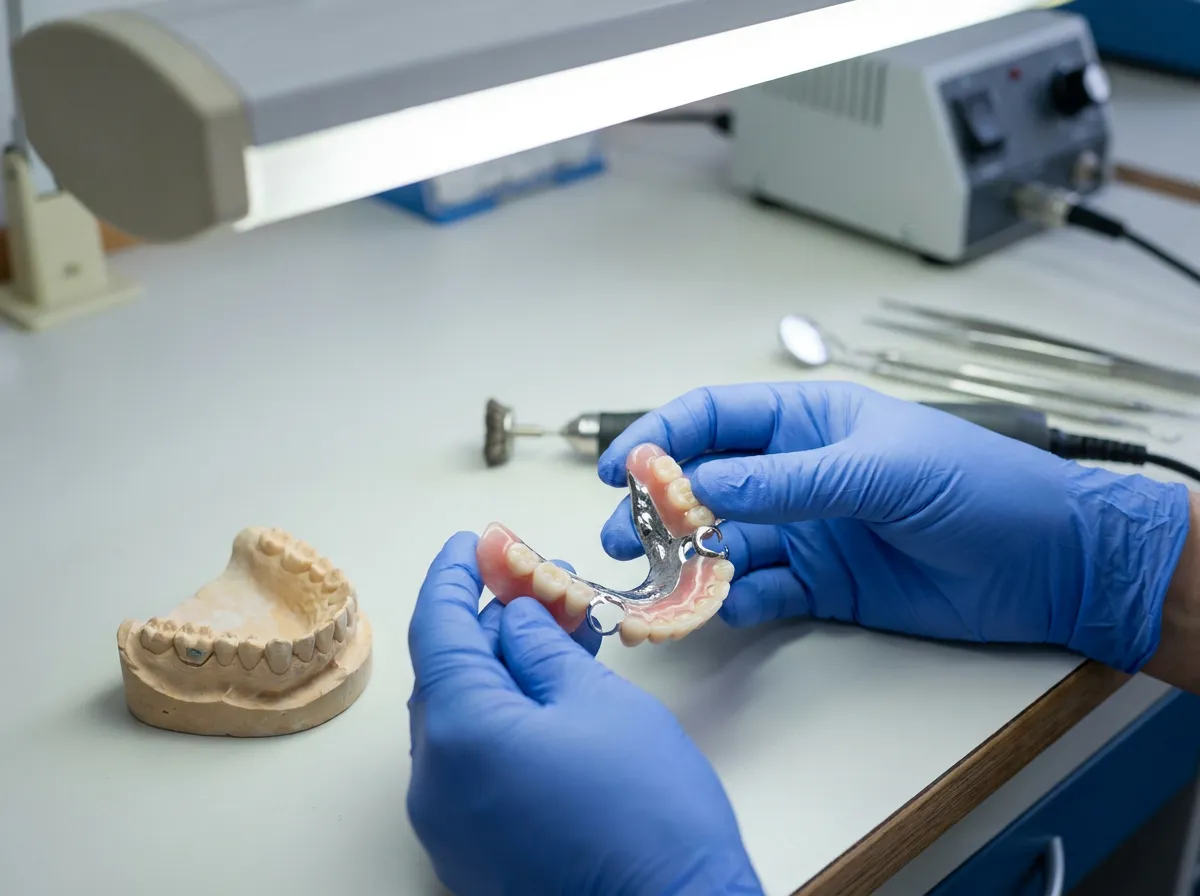
The trade-off is appearance. Metal clasps can show when you smile if they sit on front-facing teeth, so placement is worth discussing before the design is finalized. A partial denture made in a clinic that has its own laboratory can make small changes or repairs easier to coordinate, and Osmin operates an in-house lab for that reason.
Flexible Partial Dentures
Flexible partials use a thin, bendable base, and the clinic lists the Valplast and Flexite types on its partial dentures page. The clinic describes them as metal free and lightweight, which appeals to people who dislike the look of clasps or who have a metal sensitivity. They are not right for every mouth. Because the base is flexible, they usually give less rigid support than a cast frame, and how they are repaired or adjusted differs from acrylic.
If this is the type you are curious about, two of our earlier posts go into more detail: who is a good candidate for flexible dentures and how to care for flexible dentures.
Immediate Partial Dentures
An immediate partial is made in advance and placed on the day teeth are removed, so you are not left with a gap while the area heals. The trade-off is that gums and bone change as they heal, so the fit often needs adjusting and a reline later. The clinic also has a page on immediate dentures, and our guide to immediate dentures in Toronto walks through what happens before, during and after.
Precision Attachment Partials
Instead of visible clasps, a precision attachment partial connects to attachments built into crowns on your natural teeth. According to the ADA’s MouthHealthy page, crowns are usually required with attachments and the result generally costs more than a clasp design. If you want this route, ask what it would involve for the teeth that will carry the attachments, and what the cost looks like in full. Our page on dental crowns explains that side of the work.
How a Partial Denture Stays in Place
People often assume a partial denture is held by suction or adhesive. Mostly, it is not. A partial denture relies on three things working together.
- Clasps or attachments that grip the natural teeth beside the gap. This is the main source of retention.
- Rests, small ledges that sit on top of supporting teeth so the denture does not sink into the gums when you bite.
- Contact with the gums, where the base spreads some of the chewing load across the tissue under the gap.
That design explains a few common experiences. The denture clicks into place with light pressure, never by biting it into position. The ADA’s MouthHealthy page specifically warns against forcing a partial into place by biting down, because that can bend or break the clasps. It also explains why the health of the supporting teeth matters so much: they are doing a job, and the denture is only as stable as they are.
Adhesive is a separate topic. Some people use a little for extra confidence, but it should not be a substitute for fit. Our guide to denture adhesive explains what it can and cannot fix.
Who Tends to Be a Good Candidate for a Partial Denture?
There is no single checklist, and candidacy is decided at an exam. Still, the same few questions come up in nearly every assessment, and knowing them ahead of time makes the visit less intimidating.
The Health of Your Remaining Teeth and Gums
Because clasps and rests lean on natural teeth, those teeth need to be reasonably sound. Decay, loose teeth or active gum disease may need attention before a partial is made, or may change the design. Our overview of whether gum disease can be treated is a helpful read if that is a concern.
Where the Gaps Are and How Many There Are
A single missing back tooth, a gap at the front and several scattered gaps each call for different designs. Front gaps raise appearance questions, such as whether a clasp will be visible. Back gaps raise stability and chewing questions, since the biting forces are higher there.
Your Bite and Jaw Habits
Heavy grinding or clenching can stress a partial and the teeth that hold it. If you grind, mention it. A night guard is a separate device from a partial denture, and our article on night guards for teeth grinding explains when one may help.
Dexterity, Health and Daily Routine
Taking a partial in and out, and cleaning it, takes a little coordination. If arthritis, tremor, memory changes or limited mobility make that harder, say so early, because a caregiver can often be shown how to help and the design can sometimes be adjusted. The clinic also offers mobile denture services for people who cannot easily travel.
Partial Denture, Bridge or Implant: How the Options Compare
A partial denture is not the only way to replace missing teeth, and it is not always the best fit. The comparison below stays general on purpose. Costs, timelines and candidacy for any of these need an exam and a written plan.
| Option | Removable? | Relies On | General Considerations |
|---|---|---|---|
| Partial denture | Yes | Natural teeth, gums | Can replace several teeth in one appliance, needs daily cleaning, may need adjustments and relines over time |
| Fixed bridge | No | Teeth on either side of the gap, usually crowned | Needs healthy neighbouring teeth that will be reshaped, cleaning under the bridge takes practice |
| Dental implant | No | A post placed in the jawbone | Involves surgery and healing time, needs enough bone and good gum health, handled by a dentist |
| Implant-supported denture | Depends on design | Implants, sometimes with teeth | More stable than a conventional denture for many people, a longer and more involved process |
Each of these has its own page and its own trade-offs. You can read more about a dental bridge, dental implants and implant-supported dentures, and two of our blog posts compare them head to head: dental implants versus partial dentures and implant-supported dentures versus bridges. For people who want to avoid implants altogether, our article on fixing missing teeth without implants lays out the alternatives.
Who Does What: Denturist and Dentist
In Ontario, denturists make and fit removable dentures, including partials. Tooth extractions, implant surgery, fillings and crowns are dentistry. If you need teeth removed first, or a crown to support an attachment, those steps are done by a dentist, and your providers coordinate the plan. Our explainer on denturist versus dentist covers who handles which part, and you can look up how the profession is regulated at the College of Denturists of Ontario. If extractions are part of your plan, the clinic’s tooth extraction page describes that service.
What to Expect From the First Appointment to Delivery
The sequence can vary between clinics, and some steps combine, but most partial dentures follow a similar path. If you would like to hear how a first visit runs at the clinic, our post on what to expect at your first denture appointment describes it.
| Stage | What Usually Happens | What You Can Do |
|---|---|---|
| Assessment | Exam of teeth, gums and bite, a talk about goals and options | Bring your medical history, medication list and questions |
| Preparation | Any needed extractions, treatment of decay or gum problems, or crowns | Ask how long healing is expected to take |
| Impressions | Moulds of your teeth and gums are taken to build a model | Mention gag reflex or comfort needs |
| Bite record and try-in | Your bite is recorded and the teeth are tried in before the denture is finished | Check shade, shape and how it looks when you smile |
| Delivery | The partial is placed, checked and adjusted, and you learn to insert and clean it | Ask for written care instructions |
| Follow-up | Pressure spots are adjusted and your bite is rechecked | Report sore areas early instead of waiting them out |
The Canadian Dental Association notes that both partial and complete dentures are custom made from impressions of your teeth. How many appointments you need, and how long the lab takes, depends on the type of partial and the state of your mouth, so ask your provider for a schedule built around your case.
The First Weeks: Soreness, Speech, Eating and Sleep
A new partial usually feels strange before it feels natural. MouthHealthy says it may feel awkward or bulky at first, and that inserting and removing it takes practice. That matches what most patients describe. Your tongue keeps finding the new edges, and saliva may increase for a short while.
Sore Spots Are Information
If the denture presses too hard on one area, that spot will get sore. That is not something to tough out. Your denturist can adjust the denture, and MouthHealthy notes that wearing it early on can help identify those areas quickly. Follow the wear schedule you were given, and call if a spot stays tender. Our guide on adjusting to new dentures covers the first weeks in more detail, even though it is written mostly around complete sets.
Speaking
Certain sounds can feel off at first, particularly s and th. MouthHealthy suggests practising by reading aloud and repeating the words that give you trouble. Most people settle in with time, and if a sound still feels wrong after you have had some practice, the denture may need a small adjustment.
Eating
Start with softer foods cut into small pieces, chew on both sides to keep the pressure even, and avoid very sticky or hard foods while you are still settling in. That is the same advice the ADA gives. Our posts on how to eat with dentures and foods to avoid with dentures have practical ideas.
Wearing It at Night
The Canadian Dental Association says you can take a partial denture out for cleaning and at night, and MouthHealthy says that after adjustments, your dentist will probably recommend removing it before bed. Taking it out gives your gums a rest and lets you clean it. There can be exceptions, such as the first days after an immediate denture, so follow the instructions you were given for your own case. For the reasoning in depth, see our article on whether you should sleep with dentures in.
Daily Care for a Partial Denture
A partial denture adds a surface where plaque and bacteria can collect, right next to the natural teeth that are holding it. The Canadian Dental Association says dentures need cleaning every day like natural teeth, or plaque and tartar can build up and lead to stains, bad breath and gum problems, and that plaque from a denture can spread to natural teeth and gums and cause gum disease and cavities. Clean teeth matter as much as a clean denture.

| Daily Habit | How to Do It | Why It Matters |
|---|---|---|
| Rinse after meals | Remove the partial and rinse off food | Keeps food from sitting against the gums and clasp teeth |
| Brush the denture | Use a soft brush and mild soap or a cleanser your provider recommends | Removes plaque and food deposits |
| Avoid harsh products | Skip toothpaste and household cleaners on the denture | MouthHealthy warns these can be too abrasive |
| Protect it while cleaning | Stand over a folded towel or a sink of water | A dropped denture can crack or bend a clasp |
| Clean your natural teeth | Brush and floss as usual, taking extra care around clasp teeth | Clasp teeth are more exposed to plaque |
| Store it safely | Keep it in a clean, labelled case when out of the mouth | Prevents loss and accidental damage |
Metal clasps can be bent by rough handling, so avoid bending or adjusting them yourself. For step-by-step cleaning, our guide to cleaning dentures and the clinic’s denture care page are both useful. If you have a caregiver who helps, our denture care tips for seniors includes ideas for that situation.
Common Partial Denture Problems and When to Call
Most early issues are fixable with an adjustment. The table separates what is typically routine from what deserves a prompt visit. It cannot tell you what is happening in your own mouth, so when in doubt, call your provider.
| What You Notice | Often Routine | Book a Visit If |
|---|---|---|
| A tender spot on the gum | Common in the first weeks as the denture settles | It persists, looks ulcerated or keeps returning in the same place |
| The partial feels loose | Clasps can relax a little, or gums can change after extractions | It moves when you speak or eat, or food keeps getting trapped |
| Clasp feels tight or bent | A new denture can feel snug at first | It cuts into a tooth or the clasp has visibly shifted |
| Difficulty with certain sounds | Common early on and often improves with practice | It does not improve or a particular edge catches the tongue |
| Bad breath or a bad taste | Often linked to cleaning habits or food collecting under the base | It continues despite thorough cleaning |
| Crack, chip or broken tooth | Not routine | Always, and avoid gluing or repairing it yourself |
| Red, sore or burning roof of the mouth under an upper partial | Not routine | Soon. See our article on denture stomatitis |
Some situations are not for waiting. Significant facial swelling, swelling with a fever, uncontrolled bleeding, trouble breathing or swallowing, or injury to the face or jaw needs urgent medical or emergency care, not a denture adjustment. If you are unsure whether something counts, our guide to what counts as a dental emergency and the clinic’s emergency dentist page can help you decide.
Repairs, Relines and Replacement
A partial denture is not a one-time purchase that never changes. Gums and bone shift over the years, natural teeth can change or be lost, and acrylic wears. Three kinds of work keep a partial serving you:
- Adjustments to relieve pressure spots, tune the bite or tighten a clasp.
- Relines, which resurface the part that touches the gums so it fits again. The clinic’s denture reline page describes this service.
- Repairs and additions, such as fixing a cracked base or adding a tooth if another natural tooth is lost. Our guide to dealing with a broken denture explains what to do before you can get to the clinic.
A reline helps when fit has drifted. A remake is considered when the denture is worn out, the design no longer suits your mouth, or too many things have changed. For a longer view, read how long dentures last. A regular check lets your provider catch small problems early, and it also gives you a chance to ask whether the design still makes sense.
Cost, Coverage and the Questions Behind the Price
People often ask for a number first, which is understandable, but a fair price depends on the design, the number of teeth, the materials, whether extractions or crowns are involved, and how many visits are needed. Any figure published on the internet without an exam is a rough guess at best. The table lists the things that tend to move the total.
| Cost Driver | Why It Matters |
|---|---|
| Type of partial | Acrylic, cast frame, flexible and precision attachment designs involve different materials and lab work |
| Number and position of teeth | More teeth, or demanding positions, can mean more complex construction |
| Work needed first | Extractions, gum treatment or crowns are separate services |
| Follow-up and adjustments | Ask what is included after delivery and what is billed separately |
| Repairs and relines later | Long-term upkeep is part of the real cost of ownership |
For published ranges and more detail, our posts on the cost of a partial denture in Toronto, partial denture cost without insurance and flexible partial denture cost are a good starting point. Treat them as general guidance, since the right number for you comes from a written estimate.
Coverage: What the Canadian Dental Care Plan Says
The Canada.ca page on Canadian Dental Care Plan coverage lists partial dentures among removable prosthodontic services and notes that they require preauthorization. Eligibility depends on the program’s rules and on your own situation, and the clinic can tell you what paperwork it needs before treatment. Our article on CDCP coverage for dentures goes through the process, and the clinic also has a page on low income dental care. Do not assume anything is covered until the clinic confirms it for your case.
Getting a Partial Denture in North York and Toronto
Osmin Dental Clinic and Denture Laboratory is in North York near Bathurst Street and Sheppard Avenue, and serves patients across Toronto. The clinic’s own pages describe a few things that matter to people choosing a denture provider.
- Partial dentures are designed and fitted at the clinic, and the clinic operates an in-house denture laboratory.
- Mobile denture services are available for homes, long-term care facilities, hospitals and retirement residences, and the clinic lists all types of partial dentures among the services it can provide that way. Learn more on the mobile denture services page.
- The office is in a medical complex with elevators, entrances and washrooms described as accessible for patients in wheelchairs.
- The clinic’s website describes a no-obligation initial consultation. Confirm the details when you book.
You can read more about the team and the clinic on the About Us page, or go straight to contact and booking to ask a question.
Questions to Ask at Your Assessment
A good assessment is a two-way conversation. These questions tend to turn a rushed visit into a useful one.
- Which type of partial do you recommend for my mouth, and what are the other options?
- What will happen to my natural teeth, and do any need treatment first?
- Where will clasps or attachments sit, and will they show when I smile?
- How many visits should I plan for, and what happens if I need adjustments?
- What does the estimate include, and what is billed separately?
- Is any approval, such as CDCP preauthorization, needed before work begins?
- How do I care for it, and when should I come back for a check?
- What are my options if a partial is not the right fit for me?
Bring a family member or caregiver if that helps, and write down anything you want to remember afterwards.
A Gentle Next Step
If you are missing teeth and wondering whether a partial denture could work, the most useful step is a conversation with someone who can look at your mouth. You can book an appointment with Osmin Dental Clinic and Denture Laboratory to talk through your options, ask about the types we have covered here, and learn what each one would involve for you. You can also read about the clinic’s partial dentures service before you call. Nothing in this article is a substitute for that exam, and it is completely fine to take time to decide.
Frequently Asked Questions
What is a partial denture?
A partial denture is a removable appliance that replaces one or more missing teeth while you keep some natural teeth. Replacement teeth sit on a gum-coloured base held by clasps or attachments that connect to nearby natural teeth.
What are the main types of partial dentures?
Common types include acrylic partials, cast metal frame partials, flexible partials, immediate partials and precision attachment partials. Each differs in materials, appearance and support, so your denturist can explain which fits your mouth best.
How do partial dentures stay in place?
Mostly through clasps or attachments that grip natural teeth, rests that stop the denture sinking, and contact with the gums. They are not held mainly by suction or adhesive.
Are partial dentures comfortable?
Most people find them awkward at first and more comfortable with time and follow-up adjustments. Soreness in one spot usually means the fit needs adjusting, so tell your provider instead of putting up with it.
Can you sleep with a partial denture in?
The Canadian Dental Association says a partial can be removed at night, and many providers recommend it so gums can rest and the denture can be cleaned. Follow the instructions you were given for your own situation.
How long do partial dentures last?
There is no single number. Lifespan depends on the materials, how well the denture and your remaining teeth are cared for, and how your mouth changes. Regular checks, relines and repairs help it keep serving you.
Can a partial denture be repaired?
Often, yes. A cracked base, a broken tooth or a loose clasp can frequently be repaired, and a tooth can sometimes be added later. Do not glue it yourself, and ask your provider what is realistic for your denture.
Can a tooth be added to a partial denture later?
In many cases a denture can be modified if another natural tooth is lost, depending on the design and condition. A flexible or cast frame may be handled differently from acrylic, so ask your denturist.
What are the downsides of partial dentures?
They need daily cleaning, may feel bulky at first, can show clasps, and may need adjustments or relines as your mouth changes. They also rely on healthy supporting teeth, which must be looked after.
Is a partial denture better than a bridge?
Neither is better for everyone. A bridge is fixed but needs neighbouring teeth to be reshaped and crowned. A partial can replace several teeth and is removable. Your provider can explain which suits your gaps and teeth.
Is a partial denture better than an implant?
They are different treatments. Implants are placed in the jaw by a dentist and need enough bone and healing time, while a partial is removable and does not involve surgery. Compare both in an assessment.
What type of partial denture is most comfortable?
Comfort depends on fit, design and your mouth, not just material. Some people prefer the lighter feel of a flexible partial, others the support of a cast frame. A good fit matters more than the label.
Do partial dentures damage natural teeth?
A well-fitted, well-cleaned partial should not harm supporting teeth, but poor hygiene or a badly fitting clasp can. Plaque around clasps can lead to decay and gum problems, so careful cleaning and regular checks matter.
Can I eat normally with a partial denture?
Most people return to a varied diet over time. Start with soft foods in small pieces, chew on both sides, and avoid very hard or sticky foods while you adjust. Ask your provider about foods to be careful with.
How much does a partial denture cost?
It depends on the type, the number of teeth, any work needed first and the follow-up care. A written estimate after an exam is the only reliable figure. Ask what is included and what is billed separately.
Does the Canadian Dental Care Plan cover partial dentures?
The Canada.ca coverage page lists partial dentures and says they require preauthorization. Whether you qualify depends on program rules and your situation, so check with the clinic before treatment.
Can I get a partial denture if I cannot travel to a clinic?
The clinic’s website describes mobile denture services for homes, long-term care facilities, hospitals and retirement residences, and lists all types of partial dentures among them. Call to ask what can be done at your location.
When should I see someone about my partial denture?
See your provider for a persistent sore spot, a loose or bent clasp, a crack, or a sore or red area under an upper denture. Seek urgent care for significant swelling, uncontrolled bleeding or trouble breathing or swallowing.
Leave a Reply
You must be logged in to post a comment.